By Dr. Hisham Badawi, Orthodontist (certified specialist), BDS, DDS, MOrth, PhD, FRCD(C). About Dr. Badawi
Aligners change how your teeth meet, and how your teeth meet affects your jaw joints. Planned well, the risk is low. Planned without the joint in mind, it can cause or worsen jaw problems in some people.
Your jaw joint, the hip of the face
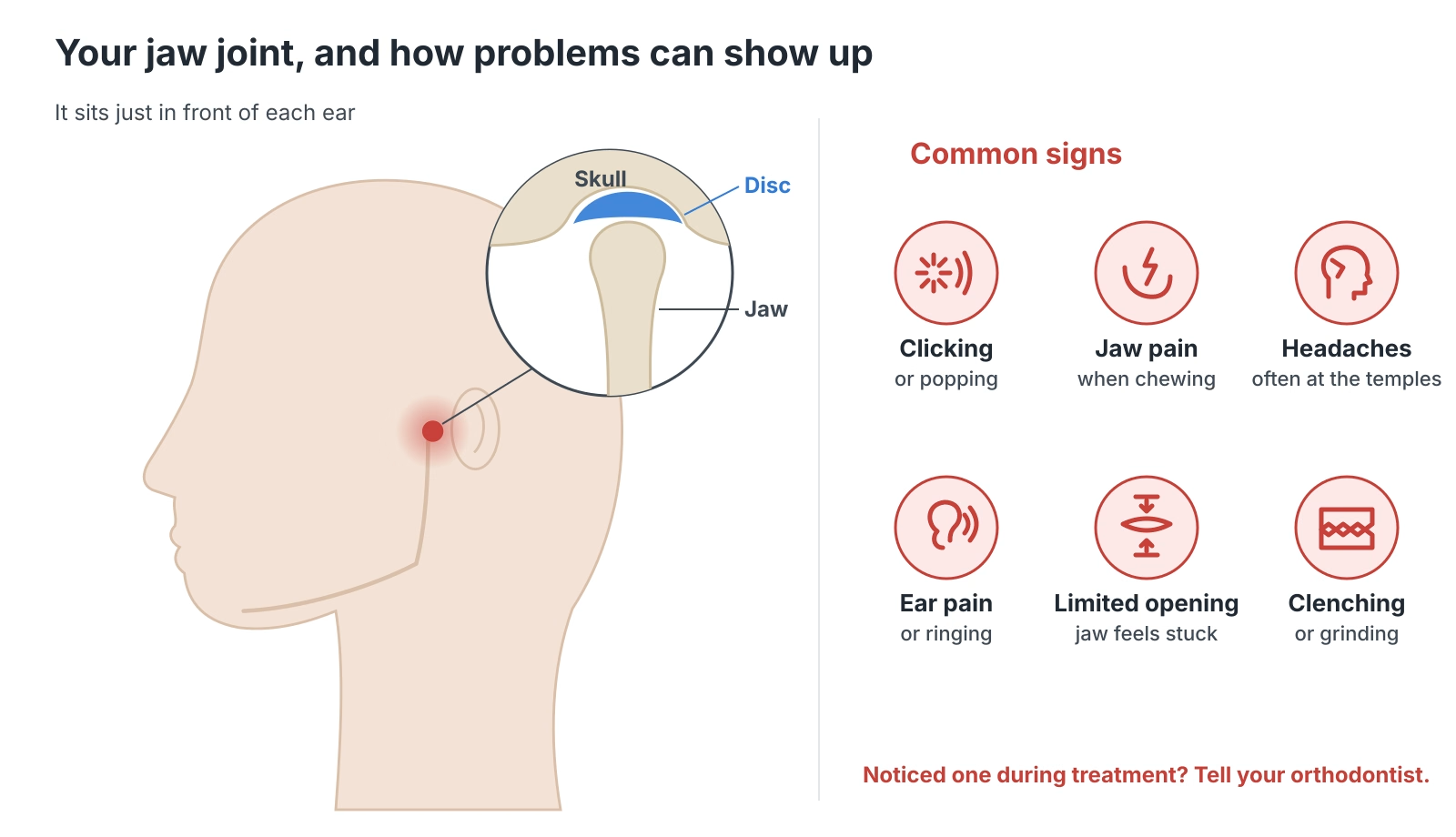
The temporo-mandibular joint (TMJ) sits just in front of each ear. It works with your jaw muscles every time you chew, speak or swallow. Problems with it (TMD) can show up as clicking, pain, tired jaw muscles or headaches.
Why aligners are different from braces
Braces tend to draw teeth slightly out of the bone. Aligners do the opposite: because the plastic covers the biting surfaces, they tend to press teeth slightly into the bone.
That can help some people whose front teeth don’t meet (an open bite). But in someone with a normal or deep bite, the back teeth can gradually stop touching. When the back teeth no longer support the bite, the jaw joints and muscles take more of the load. Dr. Badawi has seen jaw symptoms start or get worse during or after aligner treatment, and patients increasingly report it.
What the planning software doesn’t see
Aligner planning software shows your teeth, but it doesn’t model your jaw joints or how your jaw actually moves. Some programs make small automatic adjustments so the bite looks free of collisions on screen. That can give a false sense of security, because a bite that looks fine on screen hasn’t been checked against how your jaw works.
How we plan with the joint in mind
- We check how your teeth meet when you bite and slide your jaw, not just how straight they look.
- We plan so your back teeth keep supporting your bite, which matters especially in deep bites.
- Arch shape and width are part of the plan, because a narrowed arch affects how the jaw rests.
What this can and can’t do
Jaw problems have many causes, including injury, stress and clenching or grinding, and research on the role of the bite is mixed. Correcting a bite won’t cure every jaw problem. But when the bite is part of the problem, treatment planned around the joint can help, and it avoids adding new strain.
Tell your orthodontist right away if, during treatment, your jaw starts clicking or aching, your bite feels different, or your back teeth no longer seem to touch.
Related: TMJ treatment · Second opinion on your aligner treatment